Most patients expect a single number when they ask about cosmetic dentistry cost. Instead, they get a list of separate charges. Each charge ties to one clinical decision made before, during, or after treatment. Understanding these line items helps you read a quote with confidence and ask sharper questions at your consultation.
Key Takeaways
- Whether a restoration is made in-office or sent to an outside lab changes both the price and the appointment count.
- Pulp vitality testing before treatment and a 4-week recall after placement are standard steps, not extras.
- Restoring several teeth at once requires coordinated shade matching that single-tooth cases don’t need.
- Every line on an estimate reflects a step that affects how the restoration performs later.
- Material choice, from composite resin to premium ceramics, directly shapes the final price.
How the Material and Fabrication Method Shape What You Pay
Cosmetic dental treatments vary in price partly because dental materials and fabrication methods are not interchangeable. Two restorations that look similar can follow very different production paths, and those paths carry different costs.
Fabrication Method: In-Office Milling Versus the Outside Lab
The first cost driver is where the restoration gets made. A recent review of chairside zirconia systems confirms a shift in same-day dentistry. Faster in-office sintering now lets you design, mill, and finish a crown in one appointment.
When milling happens in-office, there’s no laboratory fee to pass along and no temporary restoration needed between visits. A workflow that sends the case to an outside lab adds both of those costs. The estimate usually itemizes laboratory fees separately.
Neither path is better for every case:
- In-office milling suits single-tooth restorations where speed and fewer visits matter most.
- Outside lab fabrication suits complex color blending, multi-unit bridges, or cases needing a dental professional’s hand-finishing touch.
Ask your provider which method applies to your treatment plan, since it affects both cost and schedule.
Material Selection: From Composite Resin to Premium Ceramics
The second cost driver is the material selected. A 2025 review of chairside CAD/CAM materials confirms distinct categories with different strength and esthetic profiles. The spectrum runs from entry-level acrylics through premium ceramic blocks. Block cost transfers directly into the price of the finished piece.
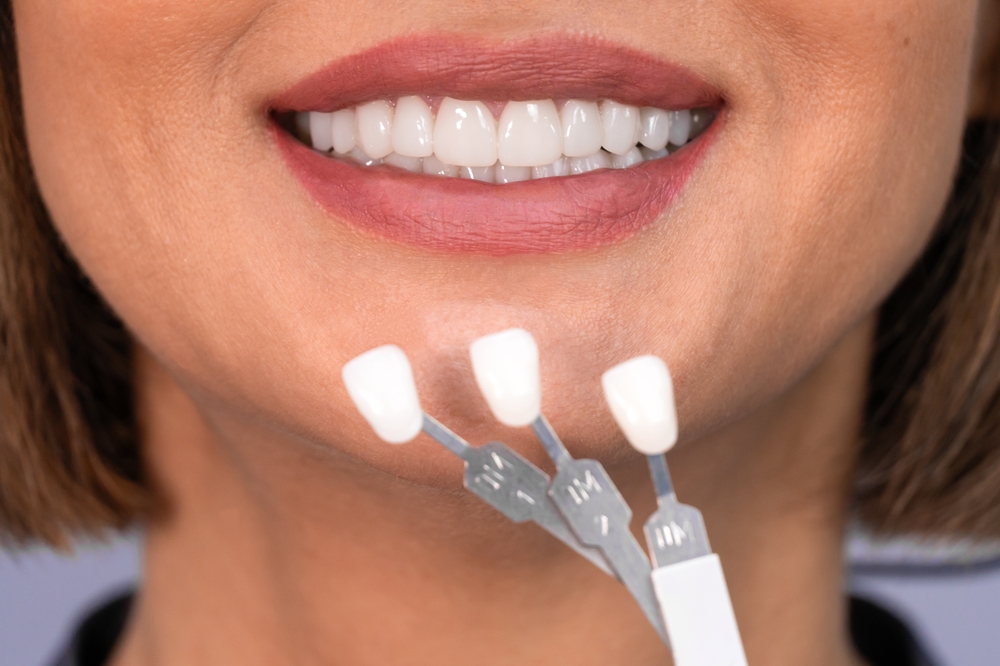
Dentists can make dental veneers from composite resin or porcelain. Porcelain veneers use a fired ceramic that reflects light similarly to natural enamel.
Composite bonding uses resin applied and shaped directly on the tooth. It typically costs less upfront but may need replacement sooner. Dentists often choose dental bonding to correct a small area without removing much tooth structure.
Quick Reference: What Drives Material Cost
- Ceramic crowns and dental crowns: a basic block costs less than a high-translucency ceramic.
- In-office professional teeth whitening: uses a higher concentration of whitening agent than take-home kits, which raises material and chair-time cost.
- Inlays and Onlays: priced by material used and whether they’re made chairside or at an outside lab.
- Tooth discoloration cases: layered ceramic work to match surrounding teeth needs more material and time than a single-shade case.
- Tooth contouring: typically the least material-intensive option on the cosmetic spectrum.
The material line on your estimate isn’t a markup. It reflects which restoration fits your tooth, your bite, and the smile you’re working toward.

What Diagnostic Work, Follow-Up Care, and Dental Procedures Actually Cover
Two categories of charges tend to catch patients off guard. One covers the diagnostic work before a visible procedure starts. The other covers the appointment scheduled after it ends. Both are standard parts of how cosmetic dental procedures get planned and completed, and both affect treatment costs.
Why Diagnostic Work Appears as a Separate Line
A cosmetic dentist doesn’t move straight from consultation to preparing a tooth. Before any preparation begins, the team checks whether the tooth’s nerve is healthy. A clinical study of tooth preparation confirms this step matters. Evaluating pulp status is a key step in diagnosing pulpal disease, not a formality.
Discovering a problem mid-procedure changes the treatment plan and the cost. That assessment exists to prevent it. Gum tissue health, bite problems, and gum disease also factor into planning before any dental restoration is placed:
- A veneer or crown over untreated gum disease won’t perform like one placed on a healthy foundation.
- Gum reshaping before a restoration is part of sequencing treatment steps correctly, not an add-on.
- These dental services get billed separately because they happen at a different stage of care.
Why Follow-Up Care Is Built Into the Protocol
A structured recall after placement is standard protocol in cosmetic dental care. One published case report on preformed veneers illustrates this step. The patient returned for a follow-up exam shortly after cementation to confirm everything healed as planned.
What Your Follow-Up Visit Checks
- Function: how the restoration is holding up under normal biting and chewing.
- Gum tissue: whether the tissue around the restoration has healed and settled correctly.
- Esthetics: whether the shade, shape, and shine still match the original plan.
A 2022 patient survey on veneer outcomes highlights this link. Satisfaction scores were notably higher among patients without gingival hyperplasia. Gingival hyperplasia is a condition where gum tissue overgrows the restoration margin. That finding is a big part of why the follow-up exists. Gum contouring as part of a restoration plan needs monitoring to confirm the tissue healed as expected.
Full treatment costs for cosmetic dental procedures cover this entire arc: diagnostic work, the procedure, and follow-up. Treatment plans that include all three stages reflect a complete clinical process. They are not a padded estimate for dental issues no one ever addressed.

Case Complexity, Smile Makeovers, and the Full Treatment Picture
A smile makeover isn’t the same procedure repeated several times. The number of teeth, the mix of procedures, and their sequence all require planning that a single-tooth case doesn’t.
Shade Matching Across Multiple Restorations
When a dentist restores every visible tooth at once, the challenge changes. When a dentist restores every visible tooth at once, the challenge changes.
A published case report on multi-unit anterior restorations captures this challenge well. The team must match the shade of full-coverage crowns and veneers across several teeth at once. The goal is one natural-looking smile, not several separate pieces.
That level of shade matching takes more planning time than repeating one procedure across multiple teeth.
How Procedure Type Adds to Case Complexity
Case complexity grows when a smile makeover draws from multiple dental specialties. A patient with bite problems may need alignment work before any restorations. Clear aligners often complete this movement before veneers or crowns. Restorations on teeth that are still shifting won’t last as long.
A published case report on combined orthodontic-restorative planning makes this point directly. Patients with significant misalignment should generally get tooth movement first, before more invasive restorative work begins.
Signs Your Case May Need Extra Planning
- More than one visible tooth needs a restoration.
- Bite problems or alignment work are part of the plan.
- A single-tooth implant, or several implants, are involved.
- Full-mouth reconstruction is on the table.
Dental implants add a different kind of complexity. A single-tooth implant involves a surgical phase, a healing period, and then crown placement. Full-mouth reconstruction cases may include implants, crowns, gum procedures, and alignment work, all sequenced over several months. Each phase has its own clinical requirements and line item.
A higher estimate for a multi-procedure case reflects that coordination. It isn’t the same case simply repeated at a larger scale.
Get Clarity on Your Cosmetic Dentistry Cost Today
Your cosmetic dentistry cost comes down to five decisions: fabrication method, material choice, diagnostic work, follow-up care, and case complexity.
Quick recap:
- Fabrication path determines whether a lab fee applies.
- Material chosen sets your base cost.
- Diagnostic work and follow-up care are standard, not optional extras.
- Multi-tooth or multi-procedure cases need coordination that single-tooth cases don’t require.
Dental insurance coverage, payment plans, and other financial options vary by case, and a printed estimate can only tell you so much on its own. Bring your questions to Dr. Sandhya Hegde at the Center for Dental Health La Jolla for a straight answer. Get in touch with our team!
FAQs
How long do porcelain veneers typically last?
Porcelain veneers typically last between 10 and 20 years with proper care, though results vary from patient to patient. Habits like chewing ice, biting nails, or unprotected nighttime grinding tend to wear down the edges faster than expected. A nightguard can meaningfully extend that lifespan. Regular checkups also let your dentist catch small chips before they turn into bigger problems.
What is the difference between composite bonding and porcelain veneers?
Composite bonding and porcelain veneers solve similar problems but behave differently over time. Composite is a resin sculpted directly onto the tooth, so if it chips, your dentist can usually repair it chairside in one visit. Once damaged, porcelain typically needs to be remade in a lab. Composite also tends to pick up staining from coffee, wine, or tobacco faster than glazed porcelain does.
Does getting veneers or crowns require removing tooth structure?
Yes, though the amount varies by case. Traditional veneers and crowns require some enamel removal so the restoration sits flush instead of looking bulky. Some patients qualify for minimal-prep or no-prep veneers, which preserve more natural tooth structure but work best on teeth that are already well-aligned. Once enamel is removed, the change is permanent, so your dentist will explain what’s reversible before starting.
How do clear aligners fit into a broader smile makeover plan?
Clear aligners typically take several months to a year before veneers or crowns, depending on how much movement is needed. Mild spacing or rotation issues may resolve quickly, while more complex bite problems take longer to correct. Once aligner treatment finishes, most patients wear a retainer to hold the new position steady while the restorative phase gets planned.
What happens at a follow-up appointment after a cosmetic procedure?
Beyond checking fit and appearance, your dentist looks for early signs that might need attention later, like minor sensitivity or a slight shift in how your bite feels. If anything feels off, small fixes like polishing an edge or adjusting the bite are usually quick at this stage. Most patients then return to their normal six-month cleaning schedule.
Citations/Sources:
- https://www.mdpi.com/2079-7737/10/11/1170
- https://pmc.ncbi.nlm.nih.gov/articles/PMC11856138/
- https://www.ncbi.nlm.nih.gov/pmc/articles/PMC11202490/
- https://pmc.ncbi.nlm.nih.gov/articles/PMC7981692/
- https://www.cureus.com/articles/114953-patient-awareness-of-soft-tissue-irritants-after-placement-of-porcelain-laminate-veneers
- https://compendiumlive.com/2026/03/estheticchallenge/
- https://www.ncbi.nlm.nih.gov/pmc/articles/PMC6712968/